


Page Contains:
Overview
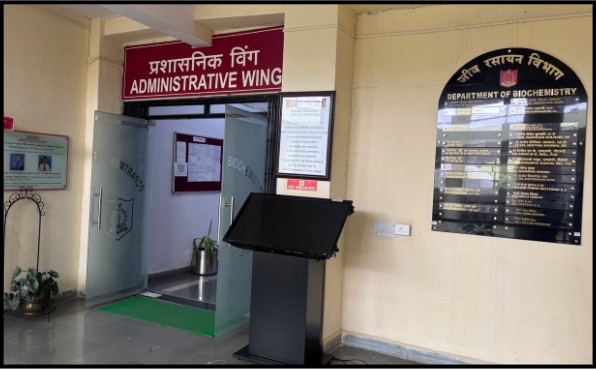
The Department of Biochemistry was established in April 1978 by amalgamation of parts of Departments of Physiology and Pathology. This department strives to achieve excellence in the fields of medical education and diagnostics by providing holistic education inclusive of up-to-date knowledge and research in the field of clinical chemistry, compassion for the patients and courtesy for fellow soldiers with an ultimate aim to fulfil the mission of this college. The department was shifted to the third floor of Diamond Jubilee block on 09 April 2012.
The Dept has adopted the philosophy of Total Quality Management in all spheres of its functioning by streamlining all the processes and systems to achieve clientele satisfaction of patients as well as clinicians.
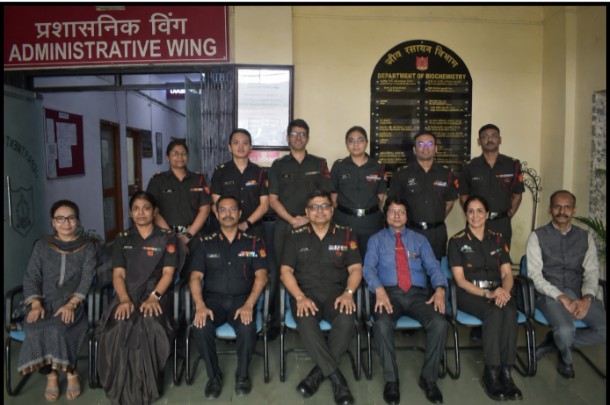
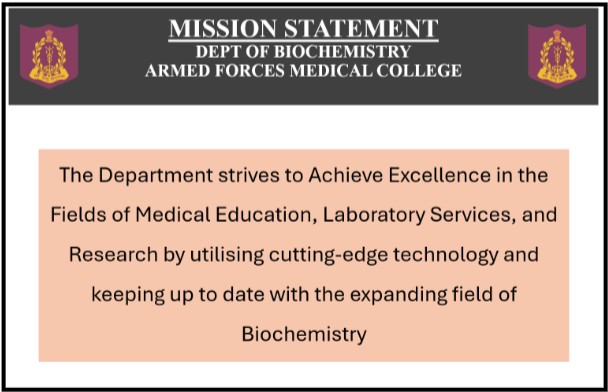
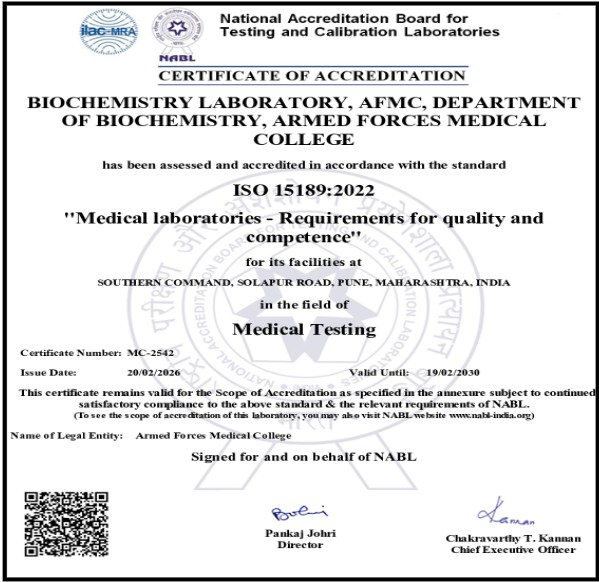
The Dept reached an important milestone in its history when it attained accreditation by NABL (National Accreditation & Calibration Board for Laboratories) as per ISO 15189(2007) on 01 Feb 2010, which was renewed in year 2012, 2014, 2016, 2018, 2020 and 2022 successfully.
National Accreditation Board for testing and Calibration Laboratories (NABL) is the only authorized and autonomous body of Govt of India, to grant accreditation in accordance with International organization for standardization (ISO) standards. It has granted NABL accreditation to Clinical Chemistry Laboratory of Dept of Biochemistry, AFMC as per the latest addition of ISO 15189 (2012).
The Dept of Biochemistry is the first NABL accredited lab in the Armed Forces Medical services and is the accredited since Jan 2010 as per ISO 15189 (2007). This accreditation has been renewed every two years. The laboratory has been successful in maintaining the quality since its first accreditation in Jan 2010 and thus the laboratory was able to achieve NABL accreditation uninterrupted for the fourth consecutive time as per the latest addition 15189(2012). The ISO has revised its standards in 2012 by further adding 87 new clauses leading to more stringent quality. The NABL reaccreditation which has been granted is applicable to almost all serum analytes as per ISO 15189 (2012) and stands valid till 14 Jan 2026.
This department has the distinction of being the first Govt sector Biochemistry Laboratory to have attained NABL accreditation. This dept also has the unique distinction of conducting an External Quality Assurance Programme for all the 119 AFMS hospital laboratories of India, including one UN MISSION laboratory. Lyophilised samples are despatched to all services laboratories quarterly. Their results are analysed and each lab is graded according to its performance. The department is engaged in the following teaching activities:
Under Graduate Courses
Post Graduate Courses
The Department?s passion for teaching can be judged by the fact that in the last five years, the MD students have been among the university toppers. The teaching methodology adopted is that of problem based learning exemplified by case discussions and Quality control clinics held by the department. The problem-based approach is a force multiplier for our students to become better practicing doctors.
The laboratory handles a massive workload of tests of approximately 2500 tests per day. It handles routine tests in clinical chemistry as well as special tests in the field of endocrinology, clinical enzymology and tumour markers. The department is equipped with modern equipment viz Two fully automated biochemistry analyser with facility of therapeutic drug monitoring, hormonal assays and electrolyte analyser (SIEMENS EXL 200). Semi- automated chemistry analysers, UV spectrophotometer, Automated gel lectrophoresis and densitometry, ISE (Ion Selective Electrode), Fully Automated Capillary Electrophoresis System (Sebia Diagnostics) and LCMS procurement is under process.
It also engages actively in meaningful undergraduate research as it believes that research is the only method of igniting young minds which propels them to the frontiers of learning. The Department has enrolled in External Quality Assurance Programmes for proficiency testing which is Bio-Rad EQAS program. Our laboratory has been rated in the excellent category by Bio-Rad EQAS program.
A patent has been granted by Indian patents office for ?A process for the preparation of a composition for the estimation of Ceruloplasmin?. The process has been developed at Dept of Biochemistry, Armed Forces Medical College, Pune. The inventors are Dr B L Somani, Scientist-G & Professor of Biochemistry, and Dr V Ambade, Scientist-F. The Patent No is 19236
The patent is about the technology for estimation of Ceruloplasmin which can be carried out using the actual physiological substrate that too in real time i.e., kinetically. The composition developed is of low cost (Rs 0.50 per test), can be completed in a short period of 60-90 seconds, require small amount of sample (50 microliters) and a simple thermostated photometer (colorimeter) which is available in almost all the clinical chemistry laboratory. The reagents are stable even at room temperature with high shelf life of more than 6 months. The various existing methods for ceruloplasmin are either using artificial substrates or end point requiring 30 min or using biohazard material based on immunoassay costing around Rs. 200/- per test and that too estimating only the ceruloplasmin as a molecule (in mg/dL) and not estimating its actual functional ferroxidase activity.

Head of the Department
Col Bhasker Mukherjee MD
Professor and HOD
Area of Interest Clinical Chemistry , Clinical Endocrinology
Facilities
Latest Information

-
Text Spacing
-
Friendly Font
-
Highlight Link
-
Line Height
-
Text Align
-
Reset